Mark 1:1-8
His name was John. People knew him locally as the Baptist. Some would say of him that he was a religious eccentric. Others, less kind, would dismiss him as a flake. He wasn’t a “how to win friends and influence people” kinda guy. He seems something of an odd choice of one to usher in the news of the Messiah’s coming. He somehow doesn’t seem to fit in with shepherds and wise men and the other folks we traditionally associate with the Christmas story. Yet, John was God’s servant chosen to prepare the way for the spectacular events that would soon follow.
Brett Blair, commenting on this passage, reminds us that, from the very beginning, everything about John was unique. His mother Elizabeth was related to Mary, the mother of Jesus. Elizabeth conceived six months before Mary. While Mary was a very young girl when she gave birth, Elizabeth was a woman in the golden years of her life. She had never given birth to a child, and you might think of her as being more in the age range of a great grandmother than mother.
And then there was John himself. When John began his ministry, he lived in the desert solitude of Judea, in a rugged wilderness. His diet consisted of honey and wild locusts and his wardrobe consisted of garments made from camel hair.
Opinion varies about the exact nature of what he wore. Hair from the back and hump of the camel was woven into a harsh material, and a softer cloth was produced from the finer hair taken from the underside of the animal. Some have thought that John might have worn a garment made from the skin, but this would have been extraordinarily heavy. It’s also thought that what John wore might have been akin to the cloak of Elijah, John’s forerunner, whose attire earned him the description “hairy man.” Elijah’s garment, as well as John’s, may have been made of camel’s hair, but harsh or soft woven—we don’t know.
We do know that John constantly brooded over the scriptures, especially the prophetic ministry of Elijah, after whom he modeled his own ministry.
John had an intimidating personality and treated everyone—whatever their station in life—exactly the same. And, perhaps for that reason the upper class folk rejected both him and his message. You can read about that in Luke 7:30.
Still, John gathered quite the following. Many came to hear him; many were baptized by him. He even drew a group of disciples around himself, which is significant for two reasons. First, some of these disciples later became disciples of our Lord. And, second, a number of people wondered if John himself was the long-expected Messiah. But John made it clear that he was not the light. No, he had come to bear witness to the light.
Now, what drew people to John and his message? Beyond his unusual attire and bizarre food habits, there was about him a faith, a God-empowered message and an anointing to bring a particular word to a particular people at a particular time. John was God’s chosen to prepare the way for the Lord.
And John the Baptist prepared the way, first, by living a godly life. In an age of corruption, John the Baptist appeared as a clean, bracing breath of mountain air. In his passionate embrace of goodness, he spoke out fearlessly against every form of corruption. John’s devotion to His God was uncompromising and complete. And the impact of his godliness, and his preaching of repentance for the forgiveness of sins, prepared the way for Jesus.
Eighteenth century economist and philosopher David Hume—who was an atheist—used to visit Haddingdon Parish Church in Scotland every year when he was nearby on vacation. The congregation was pastored by the theologian John Brown. On one occasion a man in Hume’s party referred to these visits when they met socially after the worship service.
The friend of Hume laughingly said to him, “Of course you don’t believe all that stuff the old man was saying, do you?”
And David Hume replied, “Perhaps not.”
“Then why go?”
Hume answered, “Because he believes it.”
And then Hume added, with a very serious undertone, “And I wish to God I did.”
The world has no answer to the godly life. Voltaire was once asked whether he had completely ruled out God. He shook his head. “I cannot,” he said, “Because I once met Fletcher.”
John Fletcher was an Anglican vicar and a close friend of John Wesley. His godly life was legend. It was he whom Wesley had designated as the successor to lead the Methodist people in the event of his death. But it was Fletcher who died first and John Wesley preached his funeral. He centered his message on the amazing impact of Fletcher’s goodness. There’s no answer to that kind of life.
Today, fewer than ten Tuskegee Airmen, renowned fighter pilots in World War II, remain alive. When I was directing the doctoral program at Eastern Baptist Theological Seminary in Pennsylvania, one of my students was Henry Baldwin, a Tuskegee Airman. Henry died in 2017 at the age of 91. After his time in military service, he worked as a structural designer, school district administrator and adjunct professor. He was ordained to the ministry at the age of 73, the same year he graduated from seminary with his Master of Divinity degree. He would later enter the Doctor of Ministry program where he was an inspiration to all. Henry was a kind and generous man, with a loving and gracious spirit, whose very presence ministered to all who had the pleasure of knowing him. I’ll never forget the reception he received when word spread, through a church we were visiting (in NY or DC?), that a Tuskegee Airman was in the building. Such a powerful display of honor and respect…so richly deserved! A life well-lived in dedication to his Lord and Savior; he was one through whom the Gospel was spoken in word and in deed. Like John the Baptist, John Brown and John Fletcher, Henry prepared the way by living a godly, peace-loving, God-honoring life.
Some years ago, a Communist newspaper reporter was conducting an in-depth study of a Roman Catholic order of nuns working in Paris. The hard-bitten reporter, Pierre Giraud was convinced that the good works, the loving philanthropy, the apparent tenderness of these women was just a cover for obtaining financial support for their institution.
So, he asked if he might accompany one of the nuns during a typical day. She took him down some of the most dilapidated streets he had ever seen. In the basement of one house was a man who was terminally ill. The newspaper reporter was accustomed to grim conditions but these made even him wince. The dirt and the smell were overpowering. Vermin scurried away as they approached. The sick man, who was lying on a bundle of rags, was indescribably dirty. He was trembling. His condition was the product of poverty, disease, alcohol and drugs. The nun rolled up her sleeves picked up a bowl, filled it with water, and began to wash him. Suddenly the sick man jerked up. “Sister”, he whimpered, “I am frightened.”
The Communist reporter said, “I stared in unbelief as I saw this refined, cultured woman take that filthy wreck of a man and hold him in her arms like a baby. Suddenly the hovel became heaven because love was there.”
He was overwhelmed by the goodness he saw.
The world has no answer to the Godly life. The only appropriate answer is to try to find the secret of it, imitate it, and hope others will come to know it themselves. That’s how John the Baptist prepared the way. He lived a godly life. We should each ask ourselves a question: is God preparing the way this Advent through the influence of our lives?
Second, John the Baptist prepared the way by challenging the people’s sins. One of the towering marks of ourage is the absence of guilt. A September 2017 article in Psychology Today noted that: “Feelings of guilt depend on the existence of a conscience or moral censor, some internal standard to which we hold ourselves. When we fail to live up to that standard—either letting ourselves down or worse perhaps, letting others down—we recognize that inconsistency.”
“Guilt arises,” the author noted, “when a person understands his or her misdirected behavior to be more than a simple slip or lapse. It is a failing of character. Character centers on the concept of will, the proposition that all of us can—indeed, have the obligation to—make choices, to do one thing and not another. We feel guilty when we recognize the error in question didn’t ‘just happen.’ It was caused by willful laziness, ignorance, or indiscretion. And it had a consequence for other people as well as for ourselves.
The article contained a lament that there is in our world today an encouragement to see life as little more than endless pleasure seeking, where morality has lost its broader meanings, and the self is shrunken to bypass the “scourges” of shame and guilt, and even embarrassment.
Some are pleased that guilt has been dethroned. Others see it as a bad sign. The absence of guilt in today’s society makes it very difficult to talk about sin and the need for repentance. For if there is no feeling of guilt then the need for repentance is greatly minimized if not altogether eliminated.
For many, the word repentance is a word that belongs to yesterday. It’s equated with sackcloth and ashes and mourners’ benches. Some see repentance as something that factors in only if we get caught. But repentance is far more than simply blurting out “I’m Sorry.” And repentance is not merely turning over a new leaf. No, repentance means to turn around and go in another direction.
What John the Baptist wanted his audiences to hear was this: turn your life toward this one called Messiah. Repentance is not negative nor is it down-faced. Rather, it looks up and it looks forward. It breaks the chains of oppression and death that hold us back. We mustn’t get stuck in the notion that repentance means continually feeling sorry and miserable. No! Repentance means you have stopped doing what is wrong and now you are going to do the right thing.
And it means one more thing. True repentance includes a willingness to confront sin. John the Baptist had this courage to challenge sin wherever he met it. King Herod had seduced his brother’s wife and taken her to live with him. Although the people were outraged, their religious leaders were silent. They had to tread carefully; Herod could be violent and brutal if provoked. But this wild preacher from the wilderness didn’t consider his own safety. He had eyes only for God. With outspoken courage, he denounced the king and, because of this, he was arrested. He was eventually put to death. His eyes were always only on the one who knows what is good and right and best.
There is a story told about one of Verdi’s operas. He was young and the work he would present one night had been produced in a hurry. Verdi knew that it was not his best. It was performed for the first time in Florence and, at the end, the enthusiastic—yet undiscriminating audience—went into quite unwarranted raptures and cheered the composer.
But Verdi paid little heed. He had eyes for only one man. He looked to the box where this one man sat. The adoration of the crowd would not compensate for the lack of this man’s approval. The man was the great composer Rossini, and he was not smiling.
I want the Lord to smile when He sees what I do. I want Him to find me faithful in the proclamation of His Word and in the ways in which I confront the sins so prevalent in our society. Sometimes, I worry that I may be losing my edge. Some years back, a friend opined that I wrote and spoke with a stiletto, cutting through to the heart of each matter before me. But today, too often I’m too careful, weighing my words so as not shut down conversations. I try to call out sin where I see it, but I also try to speak in such a way that I won’t close off relationships. I try to keep lines of communication open. But it’s such a tough line to walk and it’s not the approval of the crowd that matters; it’s the approval of our God, our Savior.
Much is wrong with our society. We can all make a list: the increase in violence and dishonesty, the lack of integrity in public life, the slow slide of the church into adopting the ways of the world, the decline of sexual morality, a culture of death that celebrates the elimination of the pre-born, the weak, the voiceless.
Are we willing to be the watchmen who sound the alarm? Will we call people back to God in repentance? Will we have eyes only for our Lord, not seeking the approval of the crowds or even our friends and our family members?
On this Second Sunday in Advent we salute the forerunner who prepared the way by challenging the people’s sins. He was not after the popular vote. He had eyes only for God. Are we ready to share his work and mission?
Third, John the Baptist prepared the way by pointing to Christ. John—in the desert—was in the great tradition of the Hebrew prophets. He was aware that time was running out. In his fiery message, he had no time for peripheral matters. He was not willing to splash about in the shallows.
Soon the sword of Herod’s guard would flash and his tongue would lie silent in the grave. Superficial people came out from Jerusalem to see him. They were intrigued by this strange phenomenon of a wild man preaching repentance. Frivolous things such as his dress, his diet and his fierce declamatory oratory fascinated them. They wanted to interview him and then tell all their friends about their remarkable experience. “Who are you?” they asked. His answer was curt: “I am not the Christ.” “Are you Elijah?” “No!” “Then who are you?” they persisted. John’s answer ought to be the ultimate goal of every preacher: “I am a voice.”
And finally, it was John’s crowning glory that he saw something: this wild man from the wilderness saw into the heart of his nation and into the mind of his God. This insight he has left for us and for our children forever. “Behold,” he cried as he saw Jesus approaching the river, “Behold the lamb of God who takes away the sin of the world.”
Some time ago, Gene and I watched an episode of the television program, The Crown, wherein Prince Philip is portrayed experiencing a mid-life crisis. It’s 1969, and he’s depicted as a broken, conflicted, disillusioned man, moving from one dreary official engagement to another in lackluster fashion. He’s dissatisfied with himself, with his life, and he’s at his wit’s end.
He becomes riveted by the mission to the moon that found Neil Armstrong taking that giant leap for mankind. When the three-man Apollo crew returns to Earth, they embark on a world tour and, on a visit to Buckingham Palace, Philip arranges for a 10-minute sit-down with the astronauts. He is over-the-moon excited. He expects to hear from his heroes a word of hope, power, insight, revelation—perhaps a taste of the divine. He is seeking answers that will help him make a leap of his own. Instead, he finds three young men who had been completely focused on the tasks they had before them.
When Philip presses his fellow pilots for some grand, existential observations about their experience, he receives an anecdote about how their water-cooler was a piece of junk. He learns that these “giants, these gods” were just “three little men” who were merely doing their jobs. “There wasn’t much time for [thoughts about the meaning of life],” the astronauts inform him. Just as royal life is filled with “protocol and procedure,” so is a lunar mission. “We pretty much spent our entire time with lists in our hands,” says Collins.
In that sit-down, Philip did not find the fount of wisdom he’d been seeking. The heroes had absolutely nothing to share on a spiritual, on an intellectual level…no revelations, not about the human nor about the divine. Philip is crushed, but then he turns to a group of pastors who had begun meeting in a building on the grounds of Windsor Castle. After having been initially very dismissive of them—after all, they weren’t persons of action like the astronauts—after criticizing them for seeking eternal answers through prayer and conversation, Philip concludes that—at the end of it all—all that really matters is the faith in, the trust in, the relationship with Jesus Christ. The kind of relationship that made such a difference in the life of his own mother. Philip reaches the realization that his desire for meaning, for hope, for life, can only be satisfied in the Savior.
We live in an era of pop princes and princesses, an era of superheroes and superstars, and many today are looking to these false gods for empowerment, happiness and peace. It’s no surprise that Taylor Swift was recently named Time magazine’s Person of the Year. In the article, detailing the reasons for her selection, she is called “the master storyteller of the modern era.” But there is only one Prince of Peace, only one true hero who will never let us down. It is the story of Jesus that we should be most eager and willing to tell.
There is no greater privilege given to any one of us on this side of heaven than to point to that Prince of Peace, the Lamb of God who takes away the sin of the world. And if we would have peace in our lives, we must remember that peace is not the absence of trouble but the presence of Christ. Jesus said, “Peace I leave with you; my peace I give you. I do not give to you the way the world gives. Do not let your hearts be troubled and do not be afraid.”
Charles Wesley, wrote the words to the hymn, Jesus! The Name High Over All, all 22 verses! I will close this entry with four of them:
Jesus, the name to sinners dear,
The name to sinners giv’n;
It scatters all their guilty fear,
It brings them peace of heav’n.
Oh, that the world might taste and see,
The riches of His grace!
The arms of love that compass me,
Would all mankind embrace.
Him as my righteousness I show,
His saving truth proclaim:
’Tis all my business here below,
To cry, Behold the Lamb!
Happy, if with my latest breath
I may but gasp His name:
Preach Him to all, and cry in death,
“Behold, behold the Lamb!”
This Advent live in peace, and prepare the way of the Lord by spending time with Him in prayer and contemplation. Seek Him while He may be found and point others to the Him.
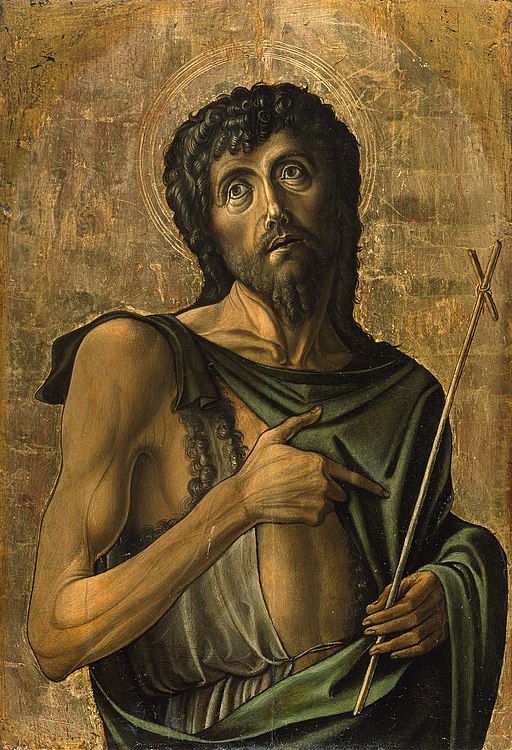
Accompanying image:: Saint John the Baptist by Alvise Vivarini, ca. 1475.
 DFG Hailson